Kitchen Drawer Organization: The 15-Minute Reset for Drawers, Counters and the Junk Drawer
Kitchen drawer organization in fifteen minutes a day. The drawer-by-drawer system — dividers, nesting, zones — behind the internet's favourite organizing ideas for the hardest-working room in the home.
- The 15-minute system: dump the drawer, divide with adjustable trays, zone by use, sweep the counters.
- Adjustable dividers beat fixed trays — they adapt when contents change.
- Deep drawers work best with nesting, lid files, and a knife dock.
- The junk drawer gets one rule and one zone — everything else is sorted or binned.
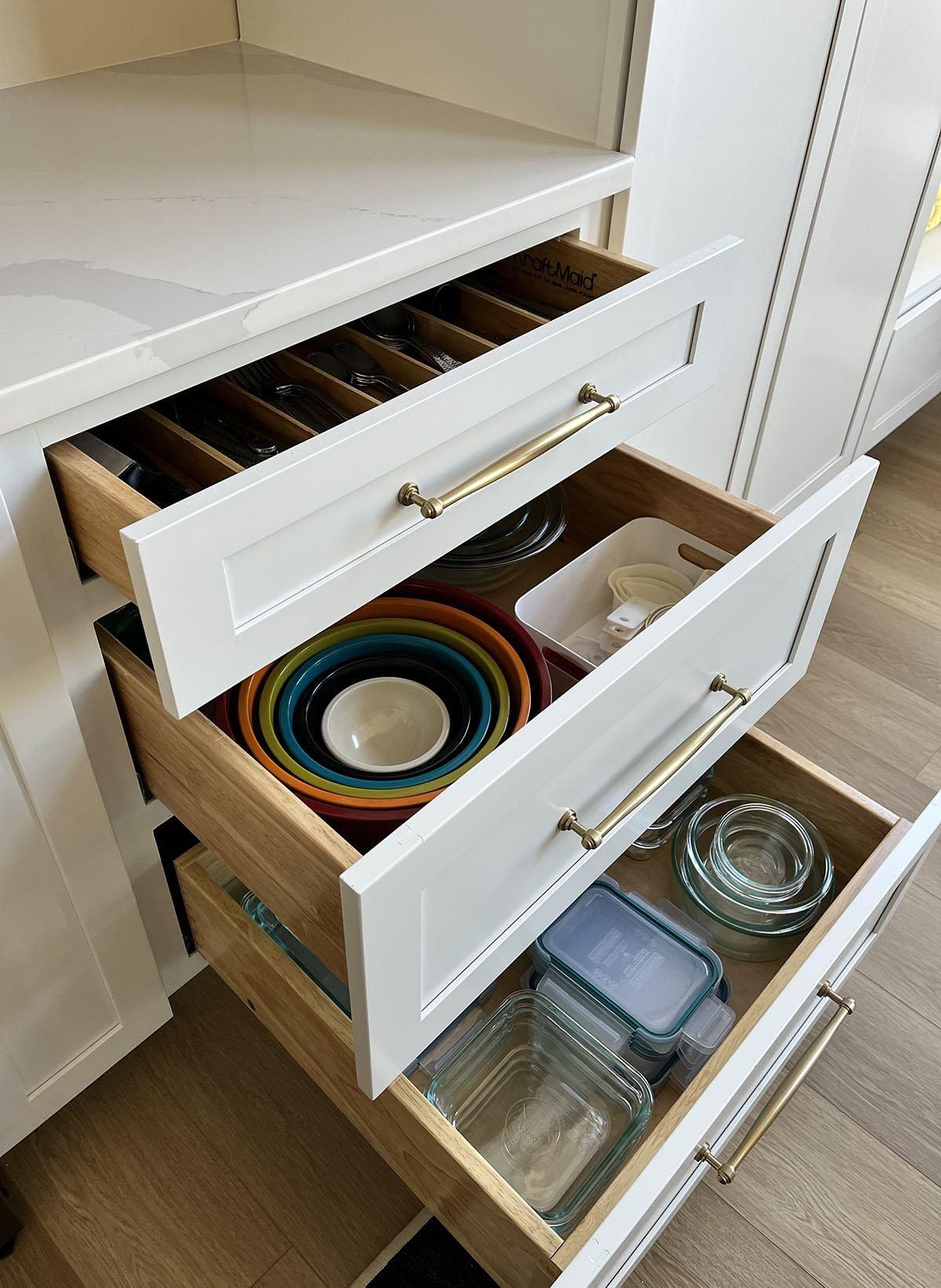
Open white kitchen drawers neatly organized with divider trays, nested bowls and glass containers
The fastest kitchen drawer organization reset starts with your single worst drawer: pull it out onto the counter, sort everything into three piles (stays, belongs elsewhere, bin), fit adjustable dividers to the empty drawer, and load it back in zones — everything used daily in front, everything weekly behind. Then give the counters a two-minute sweep. That is the whole system: dump, divide, zone, sweep. Fifteen minutes if you keep the sorting ruthless.
The 15-minute system, minute by minute
- Minutes 0–3 — Empty one drawer completely. Not two drawers, one. Lay everything on a clear counter or table so you can see the full inventory. This is what makes the reset work: you are deciding for each item once, not rearranging clutter blindly.
- Minutes 3–8 — Sort into three piles. Stays in this drawer (used weekly at minimum), belongs elsewhere (moves to another drawer, cupboard or room), and out (broken, duplicated, expired). The duplicates are the eye-opener — most kitchens contain three spatulas and one person cooking.
- Minutes 8–11 — Fit the dividers. Measure the empty drawer with a tape measure, then place adjustable bamboo or spring-loaded dividers so each zone is just big enough for its pile. Dividers go in before items, never after.
- Minutes 11–13 — Load in zones. Daily items at the front of the drawer where your hand falls when it is only half open; weekly items at the back. If you have to stretch to reach it, you use it less than you think.
- Minutes 13–15 — Counter sweep. Everything left on the counters gets a home or leaves. The counter is not storage; it is a work surface.
Kitchen drawer organization: why adjustable dividers beat fixed trays
Here is an honest opinion after years of testing organizing products: fixed compartment trays lose to adjustable dividers in real kitchens. Fixed trays assume your drawer is a standard size, and no two kitchen drawers actually are — especially in older homes and rental flats, where widths differ by centimetres from one drawer to the next. Adjustable bamboo dividers and spring-loaded dividers expand to fit whatever drawer they land in, and spring-loaded ones grip the walls so they do not slide when you yank the drawer open in a hurry.
The one case where fixed trays win is the cutlery drawer in a standard-width cabinet, where a single tray is genuinely faster than configuring five dividers. Everywhere else, go adjustable — and measure before you buy anything. A divider that rattles around is worse than no divider, because you stop trusting the system the first time it shifts.
Deep drawer organization: nesting, lids and the knife dock
Deep drawers are the most wasted space in the average kitchen, and they are where kitchen drawer organization pays off fastest, because people fill them horizontally — one layer of pots on the bottom, dead air above. The fix is vertical: nest bowls and containers inside each other, and file pot lids upright in a lid rack like books on a shelf. A lid rack is the single best purchase for deep drawers — lids are the bulk, and standing them on edge turns a rummaging drawer into a browsable one.
Knives deserve their own solution: an in-drawer knife dock. Loose knives in a utensil drawer dull their edges and are a genuinely bad idea in a house with kids. A dock lies flat in the drawer, each blade slotted into wood or bamboo, and it frees the counter block — which is just a bulky object that never needed to be on the counter in the first place.
Counters and the junk drawer: two zones, one rule each
Counters follow one rule: if it is not used daily, it leaves. The toaster, the kettle, the knife dock-free board — daily tools earn their square footage. The waffle maker you have used twice since 2022 goes to a cupboard, and this is the most common mistake we see: keeping a single-use appliance on the counter "because it was expensive." Counter space is more expensive. Group what remains on a single tray or board; six small objects read as clutter, one grouped object reads as styled.
The junk drawer — junk drawer organization starts the day you rename it the utility drawer and give every category a container with a hard limit: batteries in one section (ten maximum), tape and scissors in another, pens in a third, chargers in a fourth. The honest truth is the junk drawer always comes back — that is normal, not failure. What keeps it small is a monthly two-minute purge: open it, remove anything that has no category, done. Systems that need rebuilding every month are bad systems; this one needs only a sweep.
The 3 mistakes that kill every kitchen reset
Mistake 1: organizing before decluttering. Buying containers for things you should not own is just storage for clutter. Sort the piles first — the stays pile is always smaller than you expect, and it is the only pile that gets dividers.
Mistake 2: buying containers before measuring drawers. This deserves repeating because it ruins more resets than any other error. Drawer organizers look universal on a product page. They are not. Measure first, buy once.
Mistake 3: the marathon reset. Pulling every drawer out at once at 2 p.m. on a Saturday guarantees a half-finished kitchen at midnight and a system you abandon. One drawer a day, fifteen minutes, beats one eight-hour binge every time — the same way a nightly two-minute sweep beats a weekend deep-clean. Consistency is the entire trick; willpower is not a storage solution.
Renters, galley kitchens and kids: real scenarios
"I rent, so I can't change anything." Good news: this way of organizing kitchen drawers needs no landlord permission at all. Tension-fit dividers and spring-loaded dividers require zero screws, and the counter rule costs nothing. Renters should avoid stick-on hooks on painted surfaces but can use over-the-door and over-sink storage freely — those move with you.
"My kitchen is a tiny galley." In a galley kitchen the reset is actually easier, because there is nowhere for clutter to hide. Prioritize in this order: one drawer for prep tools, nesting for the deep drawer, and clear counters — since a galley counter is your only work surface, keeping it 80% clear is not styling advice, it is survival.
"I have kids and their stuff takes over." Give the kids' clutter its own bounded zone — one basket or one drawer section — instead of fighting it across the whole kitchen. Kids' sippy cups, snack containers and bibs in one spot stay contained; the same items spread across three drawers become the permanent mess. And the knife dock becomes non-negotiable: blades off the counter and out of the loose drawer.
Frequently asked questions
- What drawer dividers are best for kitchens?
- Adjustable bamboo or spring-loaded dividers, because kitchen drawers vary in width and depth. Measure your drawer first; a divider that fits snugly will not rattle or slide around when you open the drawer fast.
- How do I stop the junk drawer coming back?
- Give every category its own container and cap how many items each container may hold. Junk comes back when 'miscellaneous' has no boundary, so run the 15-minute reset on that drawer once a month and remove anything homeless.
- My drawers are all weird sizes. What fits in them?
- Spring-loaded dividers fit nearly any width because they expand to press against the drawer walls. For odd depths, stackable divider boxes can be mixed and matched to fill whatever space is left.