Work From Home Desk Organization: Ideas for Small Home Office Corners
Work from home desk organization ideas for small corners: cable management, vertical storage, and the work-box shutdown ritual that gives your living room back at 6 p.m.
- The desk surface holds only today's active work — everything else goes vertical or in one drawer.
- Hide cables with adhesive clips and a cable box; visible cords are half the mess.
- Under 40 inches wide? Use wall space and a monitor riser instead of desk organizers.
- End with a 5-minute shutdown ritual so your living room returns at 6 p.m.
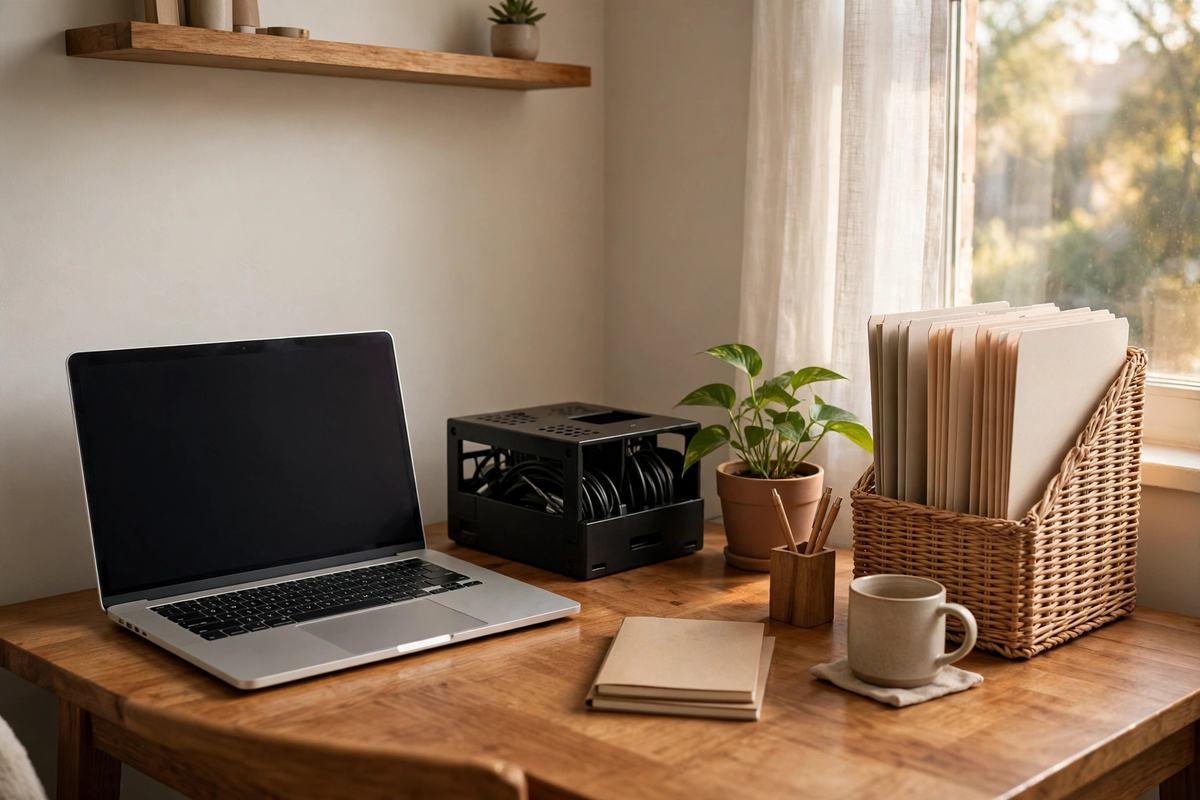
A tidy work-from-home desk corner with a plant, monitor riser and simple organizers
Work from home desk organization starts with three zones: the surface holds only today's active work — laptop or monitor, one notebook, one pen, a mug — while everything else moves into vertical storage or a single drawer or caddy, and every cable gets routed out of sight with adhesive clips and a cable box. End each workday with a five-minute shutdown: papers into one in-tray, devices docked, chair tucked in. The desk stays calm because nothing accumulates, not because you bought more containers.
Home office desk organization: what deserves a spot on the desk — and what doesn't?
Start with ergonomics: the top of your monitor should sit at or just below eye level; for a laptop, that means a 2–3 inch monitor riser stand underneath plus an external keyboard and mouse so your neck stops craning down. A monitor arm instead of the stock stand frees a surprising 6–8 inches of desk depth, which on a small desk is the difference between elbow room and clutter.
Then apply the one-day rule: if you have not touched an item during this workday, it does not live on the desk. Fewer objects in view means fewer attention leaks — and that is the whole productivity game on a small desk.
Why do pretty organizers never seem to work?
Because containers do not create decisions — they just give clutter nicer housing. Buying a drawer set before sorting is the classic mistake: you end up with beautiful boxes full of things you should have thrown away, and within a month the overflow is back on the surface. Sort first, then buy storage that fits what you kept, never the other way around.
Here is an opinionated comparison worth acting on: a vertical file sorter beats stacked trays every time. Stacked trays look neat, but the bottom tray becomes a burial ground — papers slide in and are never seen again. A vertical sorter keeps every folder's edge visible, so you actually file things instead of piling them. Same logic with drawers: an open drawer is a junk drawer waiting to happen, while a ten-dollar set of drawer dividers converts it into assigned slots — pens, scissors, sticky notes each get a home, and you can see instantly what has wandered.
Work from home desk organization, step one: how do you actually hide the cables?
Visible cables make even a tidy desk look chaotic, and cable chaos has a real fix — not a prettier power strip sitting on the surface. Run adhesive cable clips along the back edge of the desk's underside and route the monitor, charger and keyboard cables in one neat line. Put the power strip inside a cable management box and let only one cable exit to the wall outlet.
Two details most people skip: label each cable with a strip of masking tape ('monitor', 'laptop', 'lamp') so the day something dies you are not unplugging the router by accident, and stop letting the desk become a charging station. Phones, earbuds and tablets dock in one spot — a drawer with the power strip inside, or a small tray on the shelf above — not scattered across the surface where they collect dust and visual noise.
How to organize a small work desk at home when it's under 40 inches wide?
At 40 inches or less, you have room for a laptop, a notebook and a mug — nothing else. So the storage has to leave the desk entirely. A floating shelf mounted just above the desk holds reference items and a small plant without touching the work surface; a pegboard on the wall swallows headphones, scissors, notebooks and even a charging pouch. If the desk has no drawers, slide a slim rolling cart underneath or beside it — top tier for active supplies, lower tiers for stock — and it disappears into a closet at shutdown.
Where does paperwork go when you have no drawers?
Give paper exactly three homes and one decision rule. The sorter holds three folders: Action (needs you this week), Waiting (you are waiting on someone else), File (keep, no action). The rule: nothing lands anywhere else. Loose papers scattered across the desk are almost always papers that never got a decision — 'I'll file it later' is the sentence that builds paper mountains.
Process the Action folder once a day or once a week — whatever fits your workflow, but make it a real recurring appointment, not a vague intention. Anything in File older than a year gets a hard look: most 'keep' papers are digital already or will never be needed. The goal is a sorter that is never more than half full; a full sorter is just a tray with extra steps.
How do you share the dining table with family?
If your 'desk' is the dining table, storage has to be portable, not built in. Use the caddy method: a handled tote or slim briefcase holds your laptop, charger, notebook, pens and the slim laptop stand for ergonomics. It arrives when work starts and leaves when work ends — and leaving means actually leaving, into a closet or a corner, not parked on a chair where it creeps back onto the table.
The non-negotiable part: the table belongs to the family after hours. Work items that 'live' on a shared table will slowly colonize meals and evenings, and you will feel like you never left the office. A five-minute pack-up is the price of a dining room that still feels like a dining room.
Desk organization ideas for remote work: how do you shut down at 6 p.m. without a separate office?
The shutdown ritual is what makes work from home desk organization work in a small home — it is the door you close when there is no door. Take five minutes: close every tab and write tomorrow's top three tasks in the notebook, slide papers into the sorter, close the laptop or dock it in the caddy, push the chair fully in. A clear surface and a closed screen are visual cues that tell your brain the office is closed; without them, work bleeds into the evening because the evidence of it is still staring at you.
In studio apartments this matters most. The difference between a corner that 'has a desk in it' and a corner that 'is an office at night' is entirely about whether the workday visibly ends. People who skip the ritual almost always report the same thing: they never quite feel off duty.
Frequently asked questions
- How do I organize a desk with no drawers?
- Use a rolling 3-tier cart beside the desk as your drawers — it wheels into a closet at shutdown — plus a vertical file sorter for paper and adhesive hooks under the desk for headphones and bags.
- What desk setup is best for a bedroom corner?
- A small desk facing away from the bed, vertical storage above it, and a strict shutdown ritual. Never keep work items on the bed — the bed has to stay a sleep cue, not an inbox.
- How do I keep a shared table working as a desk?
- Use a handled work caddy that arrives when work starts and leaves when it ends. The table belongs to the family after hours, so work never gets to live there permanently.