Entryway Organization for Small Apartments: The Drop Zone That Stops Clutter at the Door
Entryway organization ideas for homes with barely a hallway: one tray, two hooks, a slim shoe solution and the mail rule that keeps apartment clutter from ever entering.
- The whole system is four pieces within three steps of the door: tray, two hooks, slim shoe solution, mail rule.
- No entryway at all? Build a 60 cm wall zone — it works the same.
- The mail rule stops clutter at the door: sort it standing, recycle junk immediately.
- A 60-second nightly reset keeps the drop zone from becoming a dump zone.
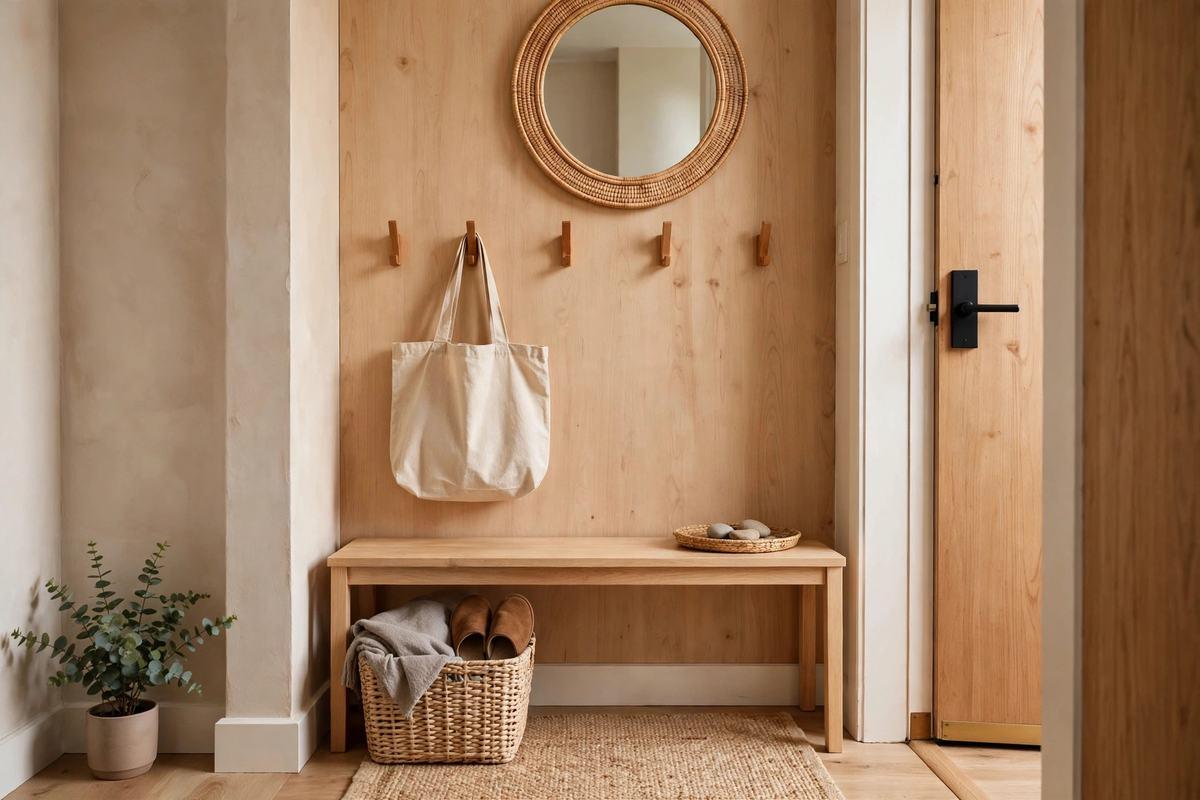
A working drop zone: hooks, a tray and slim shoe storage within three steps of the door
The direct answer: entryway organization for a small apartment is a four-piece drop zone placed within three steps of the front door — one tray for keys and wallet, two hooks for the daily bag and coat, a slim shoe solution for the 2-pair rotation, and a strict mail rule. That is the whole system. It works because clutter does not start in the living room; it walks through the front door and drops wherever it lands first. Give it a landing pad, and the rest of the apartment stays calm.
The four pieces of entryway organization
1. The tray. A tray roughly 25-30 cm wide on a shelf or narrow console, holding exactly three categories: keys, wallet, sunglasses. The tray is a boundary, not a decoration — anything that does not fit does not belong at the door. When the tray is full, something must leave before anything new lands.
2. Two hooks, at the right height. Mount hooks at about 150-160 cm so coats hang without dragging and bags are grabbable on the way out. Two hooks is the honest minimum: one for today's coat, one for today's bag. A third hook is where clutter starts breeding, so resist it unless two people share the door — then it is two hooks per person, no more.
For tiny entryway storage ideas that actually fit, a slim tilt-out shoe cabinet only 25-35 cm deep holds the daily rotation: two to three pairs. Everything else lives in the closet. The rule is blunt but effective — if a pair has not been worn in a week, it does not get door real estate.
4. The mail rule. Touch mail once, standing at the tray: recycle junk immediately into a small bin beside the door, file bills and important papers in one folder, and act on the rest within 48 hours. No mail migrates past the entryway. Ever. Paper clutter is the fastest-growing mess in small homes because it looks small until it is a mountain.
No entryway at all? Build a 60 cm wall zone
Many studios need small apartment entryway ideas because they open straight into the living room. The fix is to claim 60 cm of wall beside the door and treat it as sacred. Two adhesive hooks — the backbone of renter-friendly entryway organization, no drilling needed (quality strips hold 2-4 kg each) — a small floating tray shelf at about 110 cm for keys, and a vertical or over-door shoe rack complete the zone. A narrow console table 25 cm deep works if you have the floor space; if not, wall-mounted pieces use zero floor area. The zone does not need to look like a hallway. It needs to function like one.
Wall-mounted vs freestanding: an honest comparison
Wall-mounted entryway organization wins for genuinely tiny spaces. Hooks, a floating shelf and a wall shoe rack consume no floor footprint at all, and adhesive versions are fully renter-friendly — they come off cleanly when you move. The trade-off: weight limits (2-4 kg per hook) and no seating.
Freestanding wins if you need a bench. A slim storage bench (around 80 cm wide, 35 cm deep) gives you a seat for pulling on boots plus hidden storage for the off-rotation shoes. It costs floor space, but in a household with kids or winter boots, the sit-down factor is worth it. Our take: renters in studios should go wall-mounted; anyone with a hallway wider than a metre and boots to wrestle should consider the bench.
The 3 mistakes that kill every drop zone
Mistake 1: containers without limits. A basket with no capacity rule becomes a junk drawer standing upright. Every container in the zone needs an overflow rule — when the tray is full, the oldest item leaves.
Mistake 2: the shoe creep. It starts with "just these two pairs" and ends with seven. The 2-pair rotation is not a suggestion; audit it every Sunday and return strays to the closet.
Mistake 3: the "I'll deal with it later" mail pile. Later never comes, and the pile migrates to the kitchen counter, where it multiplies. The one-touch mail rule exists precisely because willpower does not.
The 60-second nightly reset
The drop zone is not self-maintaining — nothing is — but it is nearly so. Every night, spend 60 seconds: shoes paired and pushed in, hooks holding only tomorrow's coat and bag, tray cleared to its three categories, mail triaged. Photograph the zone when it is perfect; on chaotic days, the photo is the instruction manual and the reset takes half the time. This tiny ritual is what separates a drop zone that works for years from one that collapses by February.
Frequently asked questions
- What if I have no entryway at all?
- Claim 60 cm of wall beside the door: two adhesive hooks, a small tray shelf and a slim shoe rack create a full drop zone with zero drilling.
- How do I keep the drop zone from becoming a junk pile?
- Every item in the zone needs a container, and the zone gets a 60-second reset every night. Piles form where items have no home.
- What is the best shoe storage for a tiny entryway?
- A slim tilt-out shoe cabinet about 25-35 cm deep for the daily rotation of 2-3 pairs; the rest live in the closet. Over-door pockets work for renters.
- Are adhesive hooks strong enough for coats and bags?
- Quality adhesive strips hold 2-4 kg per hook — plenty for a daily bag or coat. Clean the wall with rubbing alcohol first, press for 30 seconds, and wait 24 hours before hanging.
- How do I stop mail from piling up?
- Touch it once at the door: recycle junk immediately, file bills in one folder, act on the rest within 48 hours. No mail travels past the entryway.