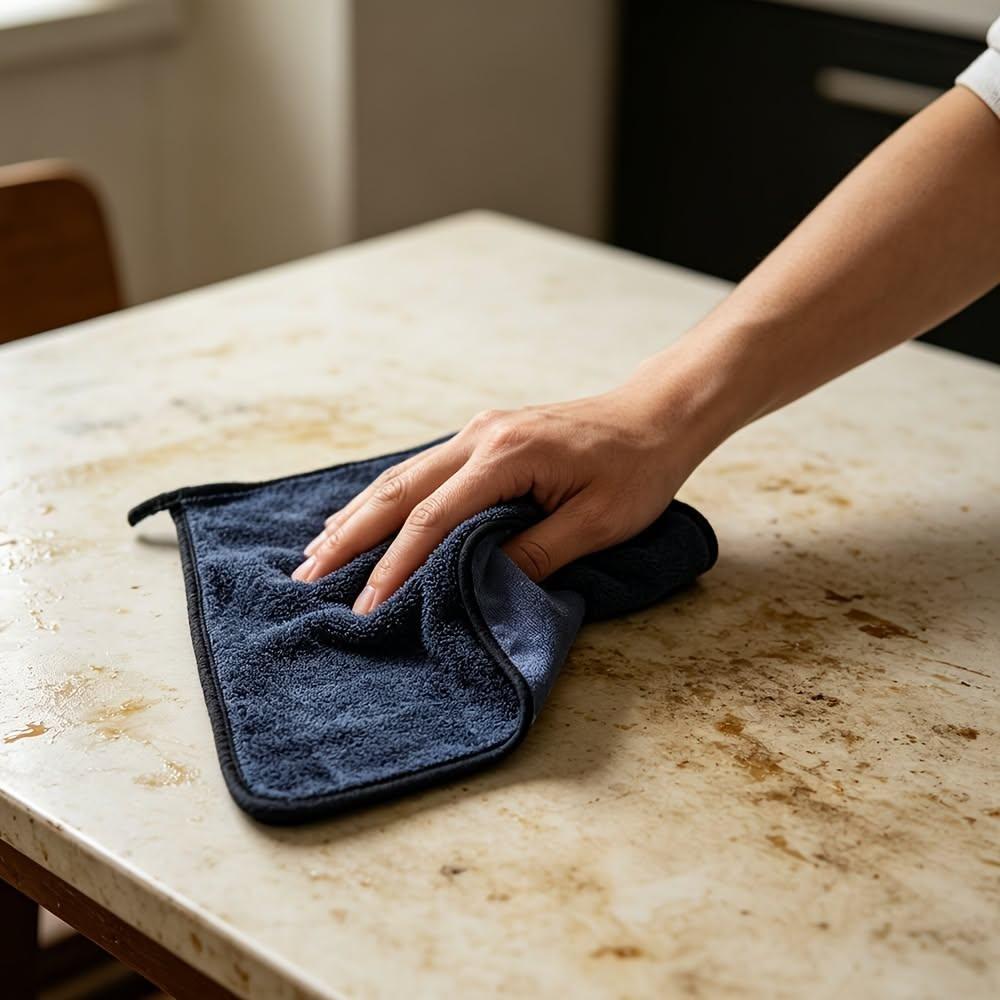
The Working Mom's Cleaning Schedule: 75 Minutes a Week, Done
Built for real life: 10–15 minutes on four weeknights, one 30-minute weekend slot, and a house that stays clean without stealing your evenings.
- The whole house runs on 75 minutes a week: 10–15 minutes on four weeknights plus one 30-minute weekend slot.
- Follow the Mon–Sun time table — each night has one job, so nothing piles up.
- Define what 'done' means on a weeknight; perfection is not the goal.
- Delegate: no medal for doing it alone — kids and partners get real jobs.

Ten focused minutes a night keeps the living room camera-ready all week
Here is a cleaning schedule for working moms that survives contact with real life: 10 to 15 minutes on four weeknights, plus one 30-minute weekend slot — 75 minutes a week total. No Saturday marathons, no guilt spiral, no system that collapses the first week someone gets sick. It works because it is built around the two truths of a working mother's week: weeknights are for maintenance, and weekends belong to rest and family, not to punishment cleaning.
Why do most cleaning schedules fail working moms?
Because they were designed for someone with hours to spare. The typical internet cleaning schedule assigns 30 to 45 minutes a day plus a full Saturday morning — roughly five hours a week. For a woman working full time, that is not a schedule, it is a second job she never applied for.
The deeper problem is the mismatch between the schedule and the actual bottleneck. A working mom's constraint is not knowledge — she knows how to clean. It is energy and fragmentation: the only available windows are the tired hour after dinner and whatever is left of the weekend. Any plan that needs an hour-long block on a Tuesday is dead on arrival, and any plan that eats the whole weekend creates resentment that kills the plan within a month.
This schedule inverts the logic. Instead of asking 'what does the house need this week?' and dividing the answer across your days, it asks 'what can a tired person reliably do in 15 minutes?' and builds the week from that. The house gets what it needs anyway, because 75 focused minutes with the right tasks beats five distracted hours with the wrong ones.
How does the 75-minute week actually break down?
The rhythm is deliberately simple: four short weeknight sessions (Monday to Thursday, 10–15 minutes each) and one 30-minute weekend slot that you place wherever the week allows. Friday is intentionally blank — a buffer night for the weeks that fall apart, or simply a night off.
Monday — Kitchen reset (15 min). Dishes handled, counters wiped, stovetop checked, one load of laundry started. The kitchen sets the tone for the whole week; a closed kitchen on Monday night makes Tuesday morning calmer.
Tuesday — Bathroom speed-wipe (10 min). Sink, toilet, mirror, and floor spot-check in the most-used bathroom only. Keep a small caddy under that sink so there is zero fetching. Other bathrooms rotate into the weekend zone slot.
Wednesday — Floors and laundry in motion (15 min). Quick vacuum or sweep of kitchen, entryway, and main living floor. Move one laundry load along — wash to dryer, dryer to basket. You are not finishing laundry; you are keeping it in motion so it never becomes a mountain.
Thursday — Bedrooms and clutter sweep (12 min). Beds made properly, one clutter sweep of flat surfaces with a basket, kids' rooms given a two-minute reset each. This is the night that makes Friday and the weekend feel genuinely restful.
Friday — Off. On paper it is a rest night. In practice it is your shock absorber: if a session got skipped midweek, do it now. If the week went perfectly, enjoy the rarest luxury — a Friday evening with nothing assigned.
Weekend — One 30-minute zone (30 min). A single rotating deep-ish task: bathrooms properly, full vacuum and mop, dusting, or bedding and towels. One zone per weekend, on whichever day suits you. It never grows, because the weeknights have already done the maintenance.
The Mon–Sun time table
The whole week on one glanceable table — about 75 focused minutes total, including the 30-minute weekend slot:
| Day | Focus | Time |
|---|---|---|
| Monday | Kitchen reset — dishes handled, counters wiped, stovetop checked, one laundry load started | 15 min |
| Tuesday | Bathroom speed-wipe — sink, toilet, mirror, floor spot-check in the main bathroom only | 10 min |
| Wednesday | Floors and laundry in motion — high-traffic vacuum or sweep, one load moved to its next stage | 15 min |
| Thursday | Bedrooms and clutter sweep — beds made, flat surfaces swept with the basket, two-minute kid-room resets | 12 min |
| Friday | Off — your shock absorber for any skipped session, or simply a night off | 0 min |
| Saturday or Sunday | One rotating 30-minute zone — bathrooms, floors, dusting, or bedding week by week | 30 min |
| The other weekend day | Off — the schedule never touches both weekend days | 0 min |
Before work vs after work: the minute split
The 10–15 minute weeknight session splits naturally across the day — and you do not need both halves to stay on track. Use whichever window your mornings and evenings actually allow:
Before work (~10 min):
- Laundry in motion — move one load along: washer to dryer, or dryer to the basket (2 min)
- Bathroom sink and mirror wiped while the coffee brews (3 min)
- Entryway and kitchen counters swept once with the basket method (2 min)
- Anything full gets tied up and taken to the bin on your way to the car (3 min)
After work (~15 min):
- Kitchen reset — dishes handled, counters wiped, stovetop checked (7 min)
- Laundry moved to its next stage, or tonight's load started (2 min)
- Living room flat-surface sweep with the basket, cushions fluffed (3 min)
- Bedrooms given the quick reset, doors closed — a closed tidy room stays tidy (3 min)
If you can only protect one half, protect the after-work one: the kitchen reset is the single highest-impact task in the whole schedule, and a closed kitchen at night makes the entire next morning calmer. But on the mornings you have ten minutes to spare, splitting the session keeps each half under ten minutes — and cleaning stops feeling like a second job when no session is ever longer than one coffee.
What counts as 'done' on a weeknight?
The sessions work because each one has a hard finish line — three to five tasks, timer on, then stop. Vague sessions expand; defined ones complete. Here is the finish line for each night:
Kitchen reset is done when: the sink is empty or the dishwasher is running, counters are wiped, the stovetop has no visible residue, and the trash is out if it is full. Not when the pantry is organized. Not when the fridge is cleaned. Those belong to a weekend zone, and letting them creep into a weeknight is how 15 minutes becomes 50.
Bathroom wipe is done when: the sink and toilet are wiped, the mirror has no spots, and the floor has no visible hair or dust clumps. Keep it to the main bathroom; a guest bathroom used twice a month does not need a Tuesday.
Floors and laundry is done when: the high-traffic floors are clear of crumbs and dust, and one laundry load has moved to its next stage. Folding is a weekend-zone or TV-time task — never let folding hijack a weeknight session.
Bedrooms and clutter is done when: beds are made, flat surfaces have been swept once with the basket method, and each kid's room has had its two-minute reset. Close the doors when you are finished; a closed tidy room stays tidy.
What do you do on the nights you are too exhausted?
Some evenings the 15 minutes do not exist. You got home late, someone was sick, work ran over — and the schedule needs a survival mode, not a lecture. The survival version is seven minutes and two tasks: the kitchen close (dishes handled, counters wiped) and the clutter sweep of the main living area. That is it. The kitchen and the living room are the two rooms that determine whether the house feels messy tomorrow morning; everything else can wait a day.
The rule that saves the schedule: never skip twice. One skipped night is life; two in a row is the start of a backlog, and backlogs are what kill systems. If you miss Tuesday, Tuesday's bathroom wipe becomes the first five minutes of Wednesday's session. Friday's blank night exists precisely to absorb one bad weeknight without guilt.
And on the truly wrecked weeks — travel, illness, deadlines — drop the whole schedule without ceremony and run survival mode until life normalizes. A schedule you can pause and resume is a schedule you will keep for years. A schedule that demands perfection will be abandoned by March.
How should the weekend 30-minute zone rotate?
Four zones, one per weekend, on rotation. The order matters less than the rotation itself — the point is that every zone gets proper attention monthly without any of them demanding a whole morning:
Week 1: Bathrooms, properly. All bathrooms, not just the main one: toilet bases, shower spray-down, mirror detail, grout spot-check. The Tuesday speed-wipes keep them presentable between these sessions.
Week 2: Floors, fully. Whole-house vacuum including under furniture edges, then mop hard floors. Move the small things — this is the one time a month the floors get real attention, so make it count.
Week 3: Dusting and surfaces. Top-to-bottom dusting of all rooms, baseboard spot-check, ceiling fan blades, light fixtures. Pair it with a podcast; dusting is the most meditative of the zones.
Week 4: Bedding, towels, and the 'floater'. All bedding washed, towels rotated, plus one floater task of your choice — the junk drawer, the fridge clean-out, the entryway reset. The floater keeps the hidden mess from accumulating silently.
If a weekend is fully booked, the zone slides to the next weekend without drama. A missed zone is not a failure; the rotation is monthly, not sacred. What matters is that some zone gets the 30 minutes most weekends, because that is what keeps the house from slowly degrading between the daily maintenance.
How do kids fit into this without it becoming a negotiation?
Kids should help, but the schedule must not depend on them. Assign age-matched zones with hard time caps, and keep every kid task under ten minutes:
Toddlers (2–4): the two-minute toy sweep with music before bed. Make it a game — 'can we beat the song?' — and accept imperfect results. The habit matters more than the outcome.
School-age (5–11): ownership of their bedroom reset (the Thursday two-minute version, done nightly) plus one weekly job like emptying small trash bins. A visual chart with checkboxes works far better than verbal reminders.
Teens: one laundry load start-to-finish weekly and responsibility for their own bathroom items. Teens respond to ownership and specific standards ('the sink must be clear') rather than vague instructions ('clean up').
The golden rule: their tasks support the schedule, they are not load-bearing. If a teen skips laundry night, the laundry still moves — you just note it and move on. A system that collapses when a nine-year-old forgets is not a system, it is a wish.
No medal for doing it alone: the delegation play
There is no prize for being the only person who cleans — and the 75-minute week gets dramatically easier when the whole household owns a piece of it. The method is one short family meeting, not a lecture: five minutes at Sunday dinner where everyone picks their zone for the week. Write it down where everyone can see it, and it stops being your job to remember.
Assign by age, not by fairness debate. Toddlers (2–4) get the two-minute toy sweep with music — a game, not a chore. School-age kids (5–11) own their nightly bedroom reset plus one weekly job like emptying small bins, tracked on a visual chart with checkboxes instead of verbal reminders. Teens take one laundry load start-to-finish weekly and keep their own bathroom items in order. And a partner gets one consistent slot — Thursday's clutter sweep or the rotating weekend zone — not vague "help when you can," which reliably means never.
Rotate the zones weekly. Nobody owns the same job two weeks running: rotation stops resentment, keeps skills shared, and means no one can claim a task is "not theirs." Post the week's assignments on the fridge next to the Mon–Sun table, and keep the time caps hard — under ten minutes per person per task. The moment a kid's job takes twenty minutes, it becomes a negotiation instead of a habit.
What if someone refuses? Shrink their zone, don't lower the standard. A teen who "won't" do a full laundry load can own just the dryer-to-basket transfer. A partial contribution that actually happens beats a perfect assignment that starts a fight — and the schedule still works, because kid tasks support the system rather than carrying it.
What supplies make this actually fast?
Speed comes from never fetching things. The working mom's kit is small and duplicated where it matters:
Two caddies, not one. A kitchen caddy (all-purpose spray, dish soap, two microfiber cloths, small brush) and a bathroom caddy (bathroom cleaner, toilet brush, two cloths, glass spray). Carrying one caddy between floors costs minutes and motivation every single night.
Colour-coded microfiber. One colour for kitchen, one for bathrooms — no thinking, no cross-contamination worry. Our microfiber guide covers the two-cloth method that makes wiping genuinely fast: damp cloth to clean, dry cloth to buff.
A stick vacuum that lives out. If the vacuum is in a closet behind the winter coats, Wednesday's floor session will be skipped. The tool you use three times a week earns a parking spot in the open; storage aesthetics can wait.
Laundry baskets as a system. One basket per person for dirty clothes, one 'in motion' basket for the load currently cycling, and one flat 'distribution' basket for clean clothes waiting to be put away. Most laundry chaos is not a washing problem — it is a basket problem.
How do you start without the house being clean first?
You do not. A maintenance schedule cannot fix a backlog — it can only prevent new ones. Trying to start the 75-minute rhythm in a house that needs six hours of catch-up will make the schedule feel broken when it is actually just misapplied. So the honest first step is a reset:
Option A — one reset weekend. Three 90-minute blocks across Saturday and Sunday: declutter sweep first, then surfaces, then floors. Put on music, get everyone involved, and end Sunday with the house at a true baseline.
Option B — three reset evenings. If weekends are sacred, do 60 focused minutes on three consecutive weeknights: night one is declutter, night two is kitchen and bathrooms, night three is floors and bedrooms. Same baseline, no weekend spent.
Then start the schedule the next morning as if it had always existed. The first two weeks are the calibration period — sessions will run long, the timer will feel bossy, and you will be tempted to add tasks. Do not. By week three the sessions shrink to their true size because the backlog is gone and the rhythm is familiar. That is when the schedule stops being a project and becomes what it is meant to be: invisible.
Frequently asked questions
- How many minutes a week does a working mom need to keep a clean house?
- About 75 focused minutes: 10 to 15 minutes on four weeknights plus one 30-minute weekend slot. The daily micro-sessions stop mess from compounding, so the weekend block never grows into a marathon.
- What should a working mom clean every day?
- Only the compounding tasks: dishes into motion, kitchen counters wiped, one laundry load moving, and a two-minute clutter sweep of flat surfaces. Dusting, mopping, and bathrooms are weekly, not daily.
- How do working moms clean when they are exhausted after work?
- Shrink the session to the two non-negotiables: kitchen reset and clutter sweep. On the worst evenings, a seven-minute kitchen close is enough. Protecting the streak matters more than finishing the list.
- Should kids help with the cleaning schedule?
- Yes, with age-matched zones, not chore lists. Toddlers can do a two-minute toy sweep; school-age kids own their bedroom reset; teens can run one laundry load weekly. Keep it under ten minutes or it becomes a negotiation.
- What is the best day for a working mom to do deep cleaning?
- Skip deep cleaning days entirely. Use a rotating 30-minute weekend zone task instead: bathrooms one week, floors the next. Small rotating blocks replace marathon deep cleans without eating your weekend.
- How do you start a cleaning schedule when the house is already a mess?
- Do one reset first: a single weekend or three focused evenings to clear the backlog. A maintenance schedule cannot fix accumulated mess. Clear the debt, then start the 75-minute rhythm the following Monday.
- How do working moms split cleaning between before and after work?
- Roughly ten minutes before work and fifteen after. Mornings cover laundry motion, a bathroom sink wipe, and a quick clutter sweep; evenings handle the kitchen reset and bedroom tidy. Use whichever half fits your energy — the split means it never feels like a second job.